Key Points:
- Mandatory Transactional Data Reporting now applies across all MAS SINs under Refresh 31.
- Existing non-TDR contractors must transition to TDR and update their internal transaction-data reporting processes.
- Refresh 31 also changes Startup Springboard eligibility, OLM access, clauses, templates, and selected SIN requirements.
- Price Reporter helps contractors manage modifications, TDR reporting, compliance, catalog updates, and ongoing GSA contract administration.
- GSA MAS Refresh 31 Changes at a Glance
- Mandatory GSA TDR Requirements Under Refresh 31
- GSA Refresh 31 Mass Modification and the TDR Transition
- GSA TDR and Price Reductions Clause Changes
- GSA MAS Refresh 31 Requirements for New Offers
- GSA Startup Springboard Requirements After Refresh 31
- GSA OLM Changes Under MAS Refresh 31
- GSA MAS Solicitation Changes to Clauses and Templates in 2026
- GSA MAS SIN Changes Introduced by Refresh 31
- GSA Refresh 31 Changes to AI Requirements
- How to Prepare for GSA Refresh 31 Requirements in 2026
- Key Takeaways on GSA MAS Refresh 31
- Conclusion
GSA MAS Refresh 31 was released on April 2, 2026, introducing several important changes to the Multiple Award Schedule program. The most consequential update is the expansion of Transactional Data Reporting (TDR) to all MAS Special Item Numbers (SINs) and mandatory participation for MAS contractors. As a result, the impact of GSA Refresh 31 in 2026 extends beyond accepting updated solicitation terms. Contractors must account for new reporting requirements and adjust contract administration processes where applicable.
Other GSA MAS Refresh 31 changes affect Startup Springboard eligibility, Order-Level Materials (OLM), solicitation clauses and provisions, templates, and requirements for selected SINs. Existing contractors and companies pursuing new MAS awards are affected differently, making it important to identify which changes apply to a specific contract or offer and what actions are required under the current solicitation.
GSA MAS Refresh 31 Changes at a Glance
The GSA MAS Refresh 31 changes extend beyond TDR and affect several areas of contract administration, offer preparation, and SIN-specific requirements. The table below summarizes the main changes contractors and offerors should review.
| Change | Who Is Affected | Practical Impact |
| Mandatory TDR | All MAS contractors and offerors | Transaction-level reporting becomes standard |
| TDR transition | Existing non-TDR contractors | Mass modification and new reporting process |
| Startup Springboard | Eligible new businesses | Eligibility narrowed |
| OLM | MAS contractors | OLM availability expanded |
| Clause updates | Contractors and offerors | Contract and solicitation requirements changed |
| SIN-specific updates | Selected contractors | Instructions, descriptions and templates revised |
The practical effect of these GSA Refresh 31 changes depends on a company’s status. Existing non-TDR contractors must transition their contracts and reporting processes, while prospective contractors must prepare offers under the current TDR framework.
Other GSA Refresh 31 requirements apply only in particular circumstances. Startup Springboard changes primarily affect qualifying newer businesses, while SIN-specific revisions matter when a contractor holds or proposes an affected SIN. For this reason, the GSA MAS solicitation changes in 2026 should be reviewed at both the program and individual contract level.
Mandatory GSA TDR Requirements Under Refresh 31
The most significant change under Refresh 31 is the expansion of GSA Transactional Data Reporting across the entire MAS program. TDR became mandatory for all MAS SINs. Previously, TDR operated as a pilot covering selected SINs, while other contractors generally operated under the traditional non-TDR framework.
For existing non-TDR contractors, the new GSA TDR requirements involve transitioning through the applicable modification process and beginning TDR according to the effective date established for the contract. New MAS offers must be prepared under the TDR framework from the outset.
MAS sales are reported through the FAS Sales Reporting Portal (SRP). Contractors therefore need reliable processes for capturing transaction-level information from orders, invoices, accounting systems, and other sales records.
GSA TDR requires contractors to report applicable transaction-level data, including:
- contract and order identifiers;
- applicable SIN;
- product, service, or deliverable information;
- quantity and unit of measure;
- price paid per unit;
- applicable order discount information, where required;
- customer and order information;
- additional reporting elements required through SRP.
Refresh 31 also addressed additional data elements, including Order Date, Ship Date, and ZIP Code Shipped To. Implementation of particular fields can depend on their availability in SRP and the type of transaction. Contractors should therefore follow current GSA and SRP instructions rather than rely on older TDR field lists.
For existing non-TDR contractors, GSA Schedule TDR reporting does not simply begin on the April 2 release date. GSA states that MAS-TDR reporting begins on the first day of the quarter following acceptance of the Participate in TDR modification.
The practical sequence is:
- Accept the applicable Participate in TDR modification.
- Identify the relevant reporting quarter and TDR effective date.
- Begin capturing the required transactional data.
- Report applicable MAS sales through SRP.
New awards are already subject to current GSA MAS TDR requirements. Existing contractors should confirm their own effective date rather than assume every MAS contract transitioned at the same time.
Price Reporter Comment: For many contractors, the main challenge with TDR is not submitting the report itself, but making sure the required transaction data is captured correctly from the start. Reporting procedures should be reviewed before the first applicable TDR period begins.
GSA Refresh 31 Mass Modification and the TDR Transition
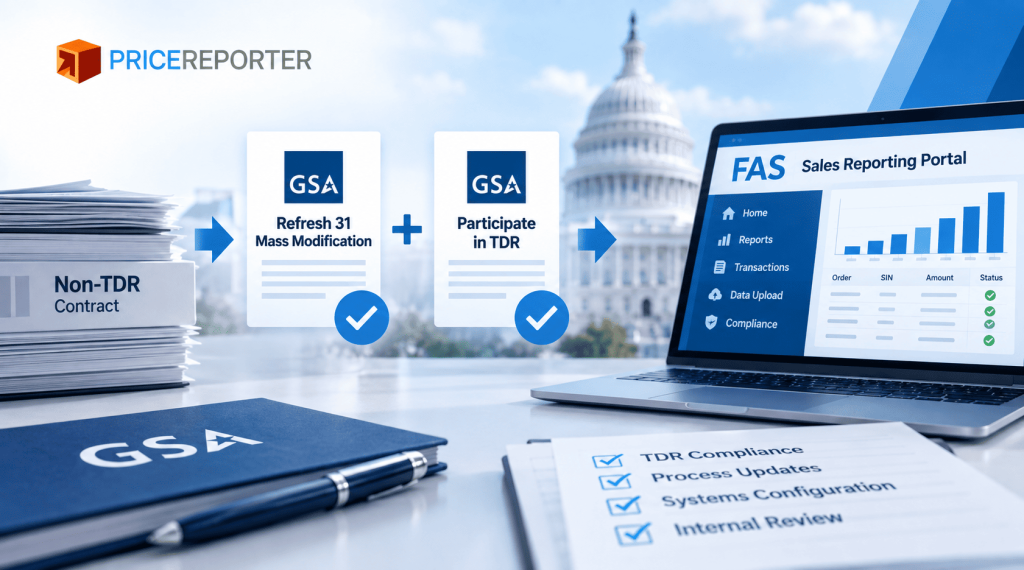
The GSA Refresh 31 mass modification is particularly important for contractors whose contracts previously operated outside TDR. Existing MAS contractors must accept the applicable Refresh 31 mass modification. Contractors transitioning from non-TDR must also accept the Participate in TDR modification within the applicable acceptance period, including GSA’s 60-day requirement for the TDR transition.
The effective date matters because it determines when the contractor moves from the former non-TDR framework to GSA TDR compliance requirements. Existing MAS contractors should:
- Verify the status of the applicable Refresh 31 mass modification.
- Confirm that TDR participation has been addressed.
- Determine the applicable TDR reporting start date.
- Configure systems to capture required transaction-level data.
- Update internal sales-reporting procedures and responsibilities.
- Review whether awarded SINs are subject to additional Refresh 31 changes.
Contractors should also maintain documentation showing how reported transaction data is generated and reviewed. This helps establish consistency between orders, invoices, internal sales records, and data submitted through SRP.
GSA TDR and Price Reductions Clause Changes
Mandatory GSA TDR also changes important elements of the pricing compliance framework that applied to non-TDR contracts. After the applicable MAS-TDR effective date, contractors are no longer required to provide Commercial Sales Practices disclosures, Most Favored Customer information, or Basis of Award information under the former framework. They also no longer maintain the BOA discount relationship or monitor price reduction violations under the former non-TDR Price Reductions Clause.
Timing is critical. Until the Participate in TDR modification becomes effective, the contractor remains subject to applicable non-TDR requirements. Publication of Refresh 31, acceptance of a modification, and the effective date of TDR participation should not be treated as interchangeable events.
The change reduces several administrative requirements associated with the previous GSA TDR Price Reductions Clause framework, but it does not eliminate pricing compliance. Contractors still need to:
- maintain accurate awarded contract pricing;
- report required MAS sales and transactional data correctly;
- support proposed pricing when required;
- comply with applicable contract pricing terms;
- maintain records supporting reported transactions.
TDR also gives GSA detailed information about actual MAS transactions. In practice, the compliance emphasis shifts away from maintaining the former commercial discount relationship and toward accurate transaction-level reporting and support for contract pricing.
Price Reporter Comment: The transition to TDR reduces some of the administrative burden associated with the previous CSP, MFC, and Price Reductions Clause framework, but it should not be treated as a reduction in pricing oversight. Contractors still need reliable pricing records and accurate transaction-level data to support ongoing GSA compliance.
GSA MAS Refresh 31 Requirements for New Offers
The GSA MAS Refresh 31 requirements also changed the starting point for companies seeking a new Schedule contract. New offers must be prepared under the current TDR framework. Offerors can no longer structure a proposal around the former non-TDR reporting model and assume the contract will transition later.
Companies preparing a new offer should:
- use the current MAS solicitation and attachments;
- follow current TDR requirements from the beginning;
- use the latest applicable templates;
- verify instructions for every proposed SIN;
- establish processes for capturing transaction-level sales data;
- prepare reporting capabilities before award.
Refresh 31 also affected non-TDR offers that were already pending when the new requirements took effect. GSA’s transition instructions required affected offerors to withdraw the non-TDR offer and submit a new offer under TDR requirements rather than continue toward award under the superseded structure.
For companies entering MAS after Refresh 31, GSA MAS TDR should therefore be treated as part of initial contract readiness rather than a post-award reporting option.
GSA Startup Springboard Requirements After Refresh 31
GSA Startup Springboard requirements became substantially narrower under Refresh 31. The program provides an alternative pathway for qualifying newer businesses that lack the operating history normally expected for a MAS offer, but Refresh 31 limited new Startup Springboard participation to companies that also qualify for FASt Lane.
FASt Lane eligibility is tied to the MAS Information Technology Category. Key eligibility conditions include, among other requirements:
- assignment to an ITC contracting officer;
- submission under qualifying ITC SINs;
- connection to an eligible federal IT initiative;
- a written request from a customer agency.
A newer company should therefore not rely on previous Startup Springboard eligibility standards when planning a 2026 MAS offer. Prospective offerors need to establish that they satisfy the current FASt Lane conditions and applicable solicitation requirements before relying on Startup Springboard as their route to a MAS award.
GSA OLM Changes Under MAS Refresh 31
The GSA OLM changes broadened access to Order-Level Materials across the MAS program. As of Refresh 31, the OLM SIN is open to all MAS contractors rather than only contractors holding SINs within previously eligible subcategories.
GSA Order-Level Materials can be used for supplies or services that are not known at the time of Schedule contract award but are necessary to support a specific order. This can help agencies obtain a complete solution when supporting items or services are required to perform the principal order.
The change has several practical implications:
- OLM eligibility is no longer limited by the previous subcategory restrictions;
- more MAS contractors can include necessary supporting materials at the order level;
- OLM cannot be used as a general vehicle for unrelated open-market sales;
- an OLM product or service cannot become the primary purpose of the order;
- contractors that did not already hold the GSA OLM SIN received a one-time opportunity to add it through the applicable mass modification.
Contractors using OLM must still follow the applicable order-level requirements. Expanded availability changes who can use the SIN, not the basic purpose of OLM within a MAS order.
GSA MAS Solicitation Changes to Clauses and Templates in 2026
The GSA MAS solicitation changes in 2026 included clause and provision revisions needed to support mandatory TDR, along with updates associated with broader federal acquisition policy changes. These technical changes matter because updated provisions become part of the contractual framework after the applicable modification is accepted.
Refresh 31 incorporated revised versions of several GSAR provisions, including:
- GSAR 552.238-80, Industrial Funding Fee and Sales Reporting;
- GSAR 552.238-81, Price Reductions;
- GSAR 552.238-82, Modifications.
Older versions and alternatives associated with the previous TDR and non-TDR structure were removed or replaced as applicable. Refresh 31 also incorporated clause and provision updates related to the Revolutionary FAR Overhaul and updates through Federal Acquisition Circular 2025-06 where necessary.
Contractors do not need to treat every clause revision as an independent compliance project. They should, however, understand which provisions govern their contract after acceptance of the applicable modification.
Other schedule-wide changes included:
- updated subcontracting templates aligned with acquisition-policy changes;
- additional TDR reporting elements for implementation through SRP;
- revisions to applicable solicitation attachments;
- updated Firearms and Ammunition language in Large Category attachments to exclude foreign replica weapons and inert ordnance from MAS scope.
These updates demonstrate why contractors should review the actual current solicitation and applicable attachments rather than focus only on the headline TDR change.
GSA MAS SIN Changes Introduced by Refresh 31
The GSA MAS SIN changes under Refresh 31 affected multiple Large Categories. Some revisions changed SIN descriptions or instructions, while others updated required templates or altered whether particular offerings could continue to be proposed.
| Area | Example of Refresh 31 Change |
| Human Capital | Instructions and descriptions revised for selected SINs |
| Information Technology | ITC labor-category requirements and SIN 561422 language revised |
| Selected SINs | SIN 311423 closed to new offers |
| Office Management | Office supply SIN instructions and templates revised |
| Professional Services | Selected auditing and training SIN requirements revised |
| Transportation & Logistics | Selected SIN instructions and templates updated |
| Travel | Selected SIN templates and SOW documentation revised |
| Miscellaneous | OLM eligibility expanded |
Several changes deserve particular attention. The Information Technology Category added direction requiring proposed ITC labor categories to be differentiated in title and description for the specific SIN under which they are proposed. SIN 561422, Automated Contact Center Solutions, was also revised to clarify that labor categories must support the total solution rather than operate as a standalone offering.
In Professional Services, instructions for SIN 541211 Auditing Services were revised, while selected training SINs received updated descriptions or instructions. Changes also affected Human Capital, Office Management, Transportation and Logistics, and Travel SINs.
Completing the schedule-wide TDR transition therefore does not necessarily address every GSA MAS Refresh 31 requirement. Contractors should check the current description, instructions, templates, and attachments for each awarded or proposed SIN.
GSA Refresh 31 Changes to AI Requirements
Early descriptions of the GSA Refresh 31 changes included proposed government AI system terms and conditions, including proposed GSAR 552.239-7001. This created an expectation before the final release that a new AI clause would be incorporated into Refresh 31.
The proposed AI clause was not implemented in Refresh 31 as initially anticipated. Contractors should therefore avoid relying on pre-release summaries that present the proposed provision as an enacted Refresh 31 requirement.
For companies offering AI-related products or services, the practical rule is straightforward: use the current MAS solicitation and applicable federal requirements when evaluating AI compliance. Pre-release Refresh 31 materials should not be treated as evidence that proposed AI language became part of the final refresh.

How to Prepare for GSA Refresh 31 Requirements in 2026
Addressing the GSA Refresh 31 requirements should begin with a contract-level review. The objective is to determine which schedule-wide and SIN-specific changes apply and whether internal processes reflect the contractor’s current obligations.
Contractors should:
- Work from the current MAS solicitation rather than pre-release Refresh 31 summaries.
- Verify acceptance and status of applicable mass modifications.
- Confirm TDR participation and the correct reporting start date.
- Test whether internal systems capture required transactional data.
- Review pricing procedures affected by the TDR transition.
- Check current instructions and templates for every awarded SIN.
- Review OLM eligibility and applicability where relevant.
- Update internal contract administration and reporting procedures.
This review should connect contract requirements with the people and systems responsible for sales, invoicing, pricing, reporting, and contract maintenance. Accepting a modification changes the contract, but operational compliance may require updates across several internal functions.
Price Reporter assists GSA contractors with contract modifications, TDR transition and reporting, catalog and contract updates, compliance, and ongoing post-award management. This can help contractors translate current GSA requirements into procedures appropriate for their individual MAS contracts.
Key Takeaways on GSA MAS Refresh 31
GSA MAS Refresh 31 was released on April 2, 2026. Its most consequential schedule-wide change was mandatory TDR across all MAS SINs. Existing non-TDR contractors must complete the applicable transition, while new offerors enter MAS under the TDR framework from the outset.
Refresh 31 also narrowed Startup Springboard eligibility, expanded OLM availability, revised clauses and templates, and changed requirements for selected SINs. Contractors should therefore treat Refresh 31 as a group of contract administration changes whose applicability depends on TDR status, awarded SINs, offer status, and other contract-specific circumstances.
Conclusion
GSA MAS Refresh 31 represents a significant change in how contractors manage reporting and pricing compliance under the MAS program. Mandatory TDR across all SINs is the central development, but contractors also need to account for changes affecting OLM, Startup Springboard, solicitation provisions, templates, and individual SIN requirements. The specific impact depends on each company’s contract status, offerings, and applicable SINs.
For existing contractors, compliance requires more than accepting the applicable modifications. Internal sales and reporting processes must reflect the new TDR framework, while contract-specific requirements should be reviewed as they change. Prospective contractors also need to build current GSA MAS Refresh 31 requirements into their offers and reporting procedures from the beginning.
Price Reporter has worked with GSA contractors since 2006 and currently manages more than 1,500 GSA contracts. With over 20,000 contract modifications completed, the company supports contractors with GSA contract management, modifications, compliance, reporting, catalog updates, and other post-award responsibilities. This experience can help businesses adapt their MAS contracts and internal processes to current GSA requirements.