Key Points:
- GSA contract management includes ongoing administration, modifications, catalog updates, sales reporting, and compliance monitoring.
- Professional contract management services help contractors maintain accurate pricing, meet reporting requirements, and prepare for GSA assessments and renewals.
- Businesses can outsource many GSA contract management tasks, but remain responsible for contractual compliance and important commercial decisions.
- Price Reporter provides ongoing GSA contract management support, with more than 1,500 contracts under management and over 20,000 modifications completed.
- Why Ongoing GSA Contract Management Matters After Award
- What GSA Contract Management Services Include
- GSA Contract Modifications and Catalog Management in Practice
- GSA Contract Compliance and Reporting Support
- GSA Contract Renewal Support and Long-Term Schedule Maintenance
- Outsourcing GSA Contract Management: Responsibilities and Next Steps
- Conclusion
Price Reporter can manage your existing GSA Multiple Award Schedule (MAS) contract and handle much of its day-to-day administration. GSA contract management typically includes contract modifications, catalog and pricing updates, reporting support, communication with GSA, and monitoring compliance requirements. The workload varies depending on the contractor’s offerings, sales volume, and frequency of changes.
An awarded MAS contract requires attention long after approval. Product lines change, suppliers adjust prices, reporting deadlines recur, and contract terms must remain accurate. Delayed updates can leave catalog information inconsistent with the contract. A third-party management provider can handle substantial administrative work, but outsourcing does not transfer the contract itself or the contractor’s legal obligations. The contract holder remains responsible for accurate data, necessary approvals, and compliance with its contract terms.
Why Ongoing GSA Contract Management Matters After Award
An awarded Multiple Award Schedule (MAS) contract lets a company offer approved products or services to eligible government buyers. It also creates continuing obligations. The price list, contract terms, and information visible to buyers must stay consistent as the business changes. Management therefore requires regular checks and timely responses to changes.
Core GSA contract administration tasks include:
- Catalog and pricing maintenance. Check whether offered items are still available, descriptions remain accurate, and published prices match approved terms.
- Contract modifications. Prepare requests for additions, deletions, SIN changes, price adjustments, and other changes that need formal approval.
- Reporting and payments. Track reportable MAS sales, follow the applicable reporting schedule, and remit the Industrial Funding Fee (IFF).
- Records and communication. Retain supporting documents, monitor GSA notices, and respond to the appropriate contracting officials.
- Contract terms and deadlines. Review mass modifications, registration information, option dates, and requirements that apply to the award.
- Assessment readiness. Keep sales, pricing, and compliance records accessible for an Industrial Operations Analyst’s review.
Neglect does not always produce an immediate warning. A discontinued product may remain listed, an approved change may not appear in the catalog, or sales records may not reconcile with submitted reports. Over time, unresolved discrepancies can require corrections during a Contractor Assessment or complicate an upcoming option review. Regular maintenance makes these issues easier to identify while supporting documents and knowledgeable employees are still available.
What GSA Contract Management Services Include
Ongoing GSA contract management can involve routine administration, individual modification projects, or a combination of both. The work typically includes maintaining contract records, tracking outstanding requests, preparing documentation, and checking whether published information matches approved terms. The required level of support depends on the contract’s complexity and the frequency of changes. For example, a company offering a limited number of professional services may have fewer catalog updates than a reseller managing hundreds or thousands of products.
Much of the work involves coordination. When a client changes its offerings, prices, suppliers, or business information, those details must be reviewed against the awarded contract. An authorized consultant can prepare supporting materials, coordinate relevant questions with the GSA Contracting Officer, and monitor the request during review. The consultant may also help address requests for additional documentation or clarification. However, the decision to approve a proposed modification remains with GSA.
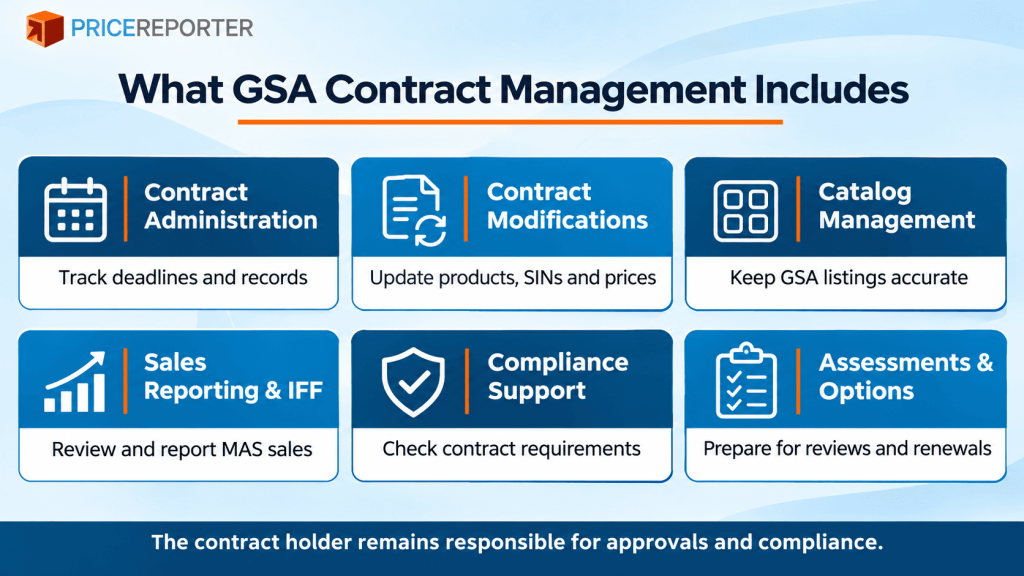
Depending on the contract and the scope of the engagement, professional management support may include:
- Routine administration: monitoring contract actions, maintaining organized records, and tracking deadlines or notices that require a response.
- Modifications: preparing requests to add or delete offerings, change approved prices, introduce SINs, or update other contract terms.
- Catalog support: preparing product or service data, assisting with FAS Catalog Platform (FCP) processes, and checking published information.
- Reporting and compliance: helping review applicable MAS sales reporting, IFF, product eligibility, and other contract obligations.
- Contractor Assessments and options: organizing records for assessments and supporting preparation for five-year option reviews.
- Market intelligence: comparing awarded prices with available market information and evaluating possible catalog expansion.
These activities are connected. For example, adding a product can require an eligibility review, a pricing proposal, a modification, and a catalog update. Handling only the submission would leave the contractor responsible for coordinating the remaining steps. A defined management arrangement can cover that sequence, while the client supplies accurate business information and makes the required decisions.
Experience with different types of MAS contracts can be useful when dealing with recurring administrative requirements and complex modifications. For example, Price Reporter has more than 1,500 GSA contracts under management and has completed over 20,000 contract modifications. However, the appropriate management approach still depends on each contractor’s awarded offerings, reporting requirements, and outstanding administrative tasks.
GSA Contract Modifications and Catalog Management in Practice
A MAS contract should reflect what the contractor is authorized to sell and on what terms. Changes inside the business do not automatically change the government’s awarded contract. Before quoting an unlisted product or applying a new contract price, a contractor must determine whether the proposed change requires GSA approval and how it should be documented.
Common reasons for a GSA contract modification include:
- Adding products, services, or labor categories that fit the awarded scope.
- Removing discontinued or noncompliant offerings.
- Requesting a price increase, decrease, or temporary price reduction under the appropriate procedure.
- Adding or deleting a Special Item Number (SIN).
- Updating information affected by a company name change, acquisition, address change, or authorized negotiator change.
These actions do not all use the same modification type. Some administrative data can be updated through a designated system workflow; changes to contractual terms require the applicable formal action. A supplier’s new price list, for example, is supporting commercial information, not automatic authorization to charge that price under MAS.
For a typical product addition, the process follows several stages:
- Collect the source data. Obtain item descriptions, manufacturer information, proposed prices, relevant certifications, and supporting commercial records.
- Check eligibility and consistency. Confirm that the items fit the proposed SIN and that the supplied information supports the intended contract change.
- Prepare the correct submission. Assemble the modification request and required pricing or catalog files using the applicable GSA process.
- Address GSA review. Respond to requests for clarification or revised documentation, and monitor the action until GSA issues its decision.
- Verify the result. Compare approved terms with the updated contract records and public catalog information.
For contracts onboarded to the FAS Catalog Platform, catalog-related modifications connect eMod with FCP. Depending on the offering, contractors may use a Product File, a Services Plus File, or a required SIN-specific template. The file is part of the modification workflow, and publication should be checked after the relevant action is approved. Existing contractors continue to move to FCP in stages, so the correct procedure depends on their onboarding status.
The final check matters as much as the submission. An approved addition is of limited use if its listing is missing, a price is displayed incorrectly, or obsolete items remain visible. A services contractor should also verify that its published price list and Terms and Conditions file reflect approved changes. Not every seller profile correction follows the same procedure as a product addition. Professional support may cover both modification preparation and subsequent catalog maintenance, depending on the agreed scope of work.
Expert Comment from Price Reporter: Before submitting a GSA contract modification, we recommend verifying that proposed changes are supported by current supplier information, accurate pricing data, and the applicable contract requirements. Identifying discrepancies before submission can help reduce avoidable corrections during GSA review.
GSA Contract Compliance and Reporting Support
Sales reporting is a continuing obligation even when a contractor makes no catalog changes. Contractors must identify sales made under their MAS contract, separate them from unrelated commercial sales, and retain records supporting the amounts reported. The FAS Sales Reporting Portal (SRP) is used for applicable submissions and Industrial Funding Fee payments. The IFF is included in reported MAS sales prices and remitted according to the applicable schedule.
Transactional Data Reporting (TDR) now applies across all MAS SINs under Solicitation Refresh 31. However, a previously non-TDR contract remains subject to its existing requirements until its Participate in TDR modification becomes effective. Under TDR, contractors report monthly line-item data through SRP, including months with no sales. IFF is generally remitted quarterly, although monthly payment is permitted. Required TDR fields differ between products and services. Contractors should map order data to the current reporting template rather than rely on a generic accounting export. They should also verify their modification status and effective reporting obligations before changing internal procedures.
Useful reporting controls include:
- Reconcile reported sales with invoices, orders, credits, and adjustments.
- Classify reportable transactions under the correct contract and SIN.
- Check required TDR fields against the current reporting template.
- Document the method used to recognize sales and apply it consistently.
- Review IFF amounts and payment status before the deadline.
Any adjustment to a prior reporting period should have a documented explanation and supporting records.
Compliance extends beyond financial reports. Product sellers may need to verify Trade Agreements Act (TAA) eligibility, country-of-origin records, and other restrictions applicable to awarded offerings. Services contractors may face different recordkeeping requirements, including labor qualifications or wage-related terms where applicable. Mass modifications and changes to contract clauses also require review: accepting an update without understanding its operational effect can leave internal procedures unchanged when they need revision.
Another important responsibility is preparing for a GSA Contractor Assessment. An Industrial Operations Analyst (IOA) reviews selected records and controls to evaluate compliance with key MAS requirements. The review may address sales reporting, pricing, contract terms, product eligibility, and related documentation. It is not the same as an Office of Inspector General audit, and its scope depends on the contract and the issues examined.
Preparation usually involves locating sales records, checking catalog and contract consistency, identifying the employees who can explain internal procedures, and resolving known discrepancies where possible. Afterward, the contractor should review the Contractor Assessment Report and address findings or recommendations requiring action. Specialized assistance may include document review, preparation for the assessment, and follow-up on identified issues. The contract holder remains responsible for maintaining accurate records and making the necessary compliance decisions.
GSA Contract Renewal Support and Long-Term Schedule Maintenance
A Multiple Award Schedule contract generally begins with a five-year base period and may continue through additional five-year options, up to the contract’s maximum term when GSA exercises them. An extension is not automatic. GSA reviews factors such as contract compliance, sales performance, and whether continuing the contract serves the government’s interests. Contractors should therefore review their status well before the current period ends.
Under current MAS requirements, contractors must achieve at least $100,000 in sales during the first five years and $125,000 during each subsequent five-year period. Reaching a threshold does not by itself guarantee an extension. GSA may consider other contract issues, and the contractor must respond to the option process and provide requested information by the relevant deadlines.
An advance review should cover:
- Contract expiration and option dates, including pending GSA correspondence.
- Sales history and any discrepancies between internal records and SRP submissions.
- Open modifications, catalog accuracy, and outstanding compliance concerns.
- Contractor Assessment findings and the status of corrective actions.
- Current registrations, business information, and any documentation requested for the option review.
Professional renewal support may include reviewing the contract’s current status, preparing supporting documentation, and coordinating procedural questions with the contracting officer. Beginning early leaves time to correct records or submit necessary actions, subject to GSA’s processing and approval requirements.
Long-term maintenance also has a commercial dimension. A contract may remain compliant while its catalog loses relevance because suppliers discontinue products, costs rise, or government demand shifts. Market intelligence can help identify price differences, commonly purchased items, and possible additions within the contractor’s capabilities. Pricing analysis should consider actual costs, approved terms, and competition rather than simply aiming for the lowest advertised price.
GSA Advantage and eBuy offer ways to observe the market and pursue appropriate opportunities. Other channels, such as FedMall, may be relevant to some businesses but are not substitutes for MAS administration. The practical goal is to keep the awarded contract accurate while making informed decisions about how to use it.
Expert Comment from Price Reporter: We recommend reviewing contract performance, outstanding modifications, and compliance records well before the next option period. Early preparation gives contractors more time to address reporting discrepancies, resolve administrative issues, and organize the documentation GSA may request.
Outsourcing GSA Contract Management: Responsibilities and Next Steps
Outsourcing can shift much of the recurring administrative workload to a specialist, but it does not transfer the MAS award. The contract holder must still know what it is offering, provide reliable records, approve business decisions, and fulfill its contractual obligations. A written scope of services should make those boundaries clear before work begins.
| Activity | External management provider | Contract holder’s role |
| Contract modifications | Prepare materials and assist with submissions and follow-up | Supply source documents and authorize proposed changes |
| Catalog management | Support updates and check publication | Confirm product, service, and pricing accuracy |
| Pricing | Analyze prices and prepare supporting materials | Make commercial pricing decisions |
| Sales reporting | Assist with applicable reporting processes | Maintain accurate sales records and remain responsible for compliance |
| Contract compliance | Review requirements and help organize responses | Operate compliant processes and approve representations |
The specific allocation may differ by engagement. A contractor may retain an internal administrator while using outside support for complex modifications, or it may arrange broader ongoing coverage. In either case, timely access to accurate company information is essential. No consultant can independently verify an unreported supplier change or an order that is missing from the client’s records.
Starting a management engagement typically involves five steps:
- Review the awarded contract, SINs, catalog, current reporting status, and upcoming dates.
- Identify open modifications, discrepancies, notices, and other priority tasks.
- Define which administrative tasks will be delegated and which decisions require internal review or approval.
- Establish contact points, document-sharing procedures, and a schedule for status updates.
- Begin the agreed work and revisit priorities as the contract or business changes.
An initial review helps determine whether the immediate need is a single modification, a reporting correction, catalog maintenance, or broader ongoing administration. The appropriate management arrangement should reflect the contractor’s actual workload, available internal resources, and outstanding obligations. Clearly defined responsibilities help ensure that administrative tasks are completed without removing the company’s control over important contractual and commercial decisions.
Conclusion
Managing an active GSA contract requires more than occasional catalog updates or modification requests. Contractors must monitor reporting obligations, maintain accurate pricing and product information, respond to changes in contract requirements, and prepare for assessments and option periods. Many of these administrative tasks can be delegated to specialists, but responsibility for meeting contractual obligations remains with the company holding the award.
Price Reporter is one of the providers offering professional GSA contract management, including modification support, catalog maintenance, pricing analysis, and compliance-related assistance. Businesses considering outside management should first assess their current administrative workload, outstanding contract issues, and available internal resources. This helps determine which responsibilities can reasonably be outsourced and what level of professional support is appropriate.