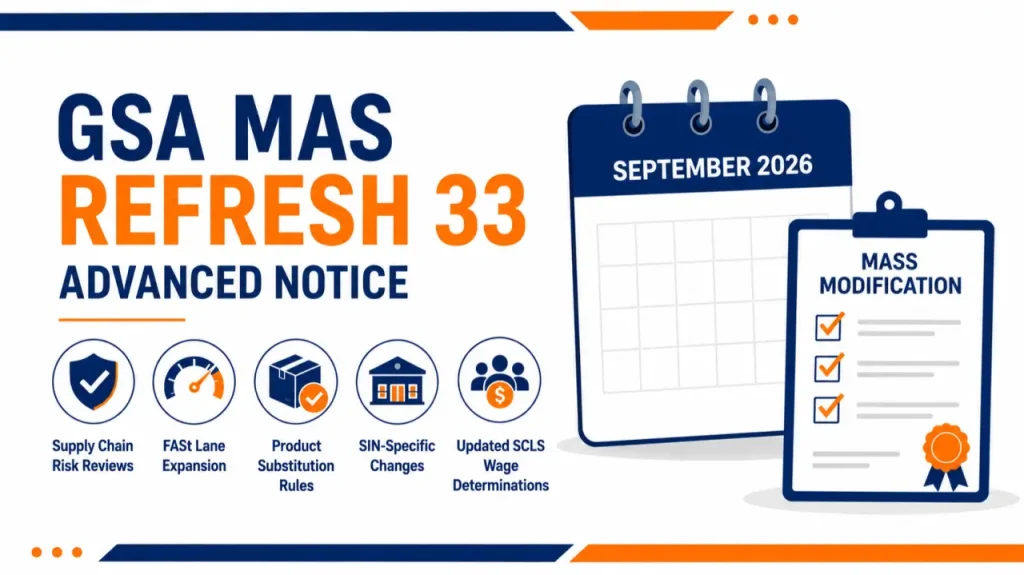
GSA MAS Refresh 33 is now published. The refresh expands FASt Lane eligibility, formalizes supply-chain risk requirements, introduces specific controls over product substitutions, and updates several Special Item Numbers (SINs). For contractors, the practical work extends into proposal preparation, supplier documentation, order fulfillment, and category-specific pricing.
Product substitutions require prior written buyer approval
Refresh 33 adds a product-substitution requirement to the General Information section of each Large Category attachment. The rule has three conditions:
- Obtain the buyer’s written consent before substituting the product.
- Use a replacement that is listed on the MAS contract.
- Keep the replacement price at or below the original item’s price, unless the customer explicitly approves a more expensive MAS-listed alternative.
A lower price does not eliminate the approval requirement. Neither does a manufacturer’s statement that the replacement is equivalent or an upgraded model. Under this rule, written buyer consent and MAS contract coverage are separate conditions.
Consider a simple example: the ordered product is unavailable, and the supplier offers a newer model for the same price. Before fulfillment, the contractor should verify that the replacement is awarded on its MAS contract and obtain the buyer’s written approval.
A practical internal control is to require the order record to identify the original item, proposed replacement, applicable price, and buyer approval before a substitute is released for shipment.
Share that procedure with customer service, purchasing, and any suppliers that ship directly to government customers. Keeping the instruction only in the contract manager’s files leaves the people making fulfillment decisions without the information they need.
Supply-chain risk review continues after award
Refresh 33 incorporates two GSAR Part 540 requirements: 552.540-70, Notice of Evaluation of Supply Chain Risk, and 552.540-71, Supply Chain Risk Monitoring. GSA describes the change as formalizing existing supply-chain requirements within a consistent agency-wide framework.
The revised offer instructions explain what the evaluation can cover. GSA may review corporate ownership, control, affiliations, subsidiaries, proposed products and services, and related supply chains. Its review may draw on government information, commercial supply-chain tools, public sources, and information submitted by the offeror. The depth of the review is tied to the risk presented by the offer.
For existing contractors, the monitoring clause is particularly important. It provides for monitoring throughout performance and corrective action when identified risks cannot reasonably be mitigated. Available remedies include removing a product, service, or solution; declining to extend performance; canceling the contract; or terminating it.
Our recommendation is to review whether your supporting records tell a consistent story. Corporate ownership information, product country-of-origin data, supplier authorization, and compliance representations should be accurate and supportable.
That review should also have an owner after award. A supplier change, acquisition, or change in product sourcing deserves attention before outdated information is reused in another submission.
FASt Lane expands across MAS categories, but federal demand still determines eligibility
FASt Lane eligibility now extends across all MAS Large Categories. Qualifying offerors must demonstrate a validated federal requirement through agency sponsorship or documented customer demand. The expansion does not make expedited processing available to every applicant simply because they request it.
For companies outside the IT Category, this creates an additional route to consideration when a federal customer has a specific need. However, the expansion applies to offers only outside IT. FASt Lane modification processing remains limited to the IT Category and designated FASt Lane-eligible initiatives. Existing eligibility and participation standards continue to apply.
Startup Springboard is still conditional
Startup Springboard is available across Large Categories, but participation remains limited to eligible FASt Lane participants. The category expansion should not be read as unrestricted Springboard access for every newer company. The offer instructions also state that existing Springboard contractors may remain on Schedule and will be evaluated at option time.
The webinar Q&A addresses a related issue for joint ventures: a generic sponsorship letter may not satisfy FASt Lane eligibility when it fails to establish a qualifying opportunity or specific federal need.
Before relying on an agency letter, review whether it actually documents the requirement supporting the request. A general expression of interest and a documented federal need are not the same thing.
Check the status of an existing draft offer
GSA’s instructions specifically address FASt Lane-eligible offerors with draft offers that have not yet been submitted: they must start a new application in eOffer to maintain FASt Lane eligibility. This is not an instruction to withdraw every offer already submitted for review.
For an offer team, checking eligibility and the application workflow before completing the package is a useful way to avoid rebuilding work later.
The former FPI and AbilityOne TAA exemption is removed
Refresh 33 implements Class Deviation CD-2026-03, eliminating the Trade Agreements Act exemption previously applicable to Federal Prison Industries, Inc. and AbilityOne Participating Nonprofit Agencies.
GSA’s implementation guidance states that products offered through MAS, including products sourced through FPI and AbilityOne, must meet the applicable TAA requirements. Contractors should not continue relying on the former exemption to support a noncompliant listing.
This does not remove the separate AbilityOne requirements. The offer instructions continue to address authorized distributor status and prohibit inclusion of commercial products that are essentially the same as AbilityOne products.
The appropriate follow-up is a product-level sourcing review. Confirm the country-of-origin information and the basis for TAA compliance rather than assuming that participation in a particular supply program resolves both questions.
Updated wage determinations warrant a cost review
Refresh 33 incorporates updated Service Contract Labor Standards (SCLS) wage determinations. GSA’s current wage-determination resources identify the refresh as the October 2026 release. Significant_Changes_Attachment
Service contractors should review the determinations relevant to their covered work and assess their effect on performance costs and pricing assumptions.
For a practical review, bring together the contract manager, pricing team, and the person responsible for labor compliance. Identify the affected labor categories, check the applicable requirements, and determine whether any pricing action needs to be discussed with the GSA Contracting Officer.
SIN-specific changes require a separate review
The overall solicitation changes do not capture everything a contractor needs to assess. Refresh 33 also revises scope descriptions, subgroup options, statements of work, and pricing templates.
Facilities: Roofing services are explicitly addressed
For SIN 238160, Roofing Products and Services Solutions, the revised description expressly permits requirements for materials only, services or labor only, or a combination of both. Standalone roofing services are explicitly within scope for roof repair or replacement, subject to the applicable ordering limitations and guidance. Significant_Changes_Attachment …
Roofing contractors should compare their awarded offerings and proposal descriptions with the clarified scope. A labor-only requirement should not be described as though a product purchase is always necessary under this SIN.
Facilities: Temporary structures and integrated base-camp support
For SIN 532490P, Lease/Rental of Pre-Engineered/Prefabricated Buildings and Structures, the revised description addresses general temporary-facility needs and turnkey solutions where the primary requirement is the lease or rental of covered structures.
The instructions include integrated operational support, such as laundry, housekeeping, and restroom or shower servicing, when directly related to the leased or rented structures. Meals, dining-facility operations, and food services are within scope only as part of a total turnkey base-camp solution, not as standalone offerings under this SIN. Substantial initial installation costs also trigger the requirement to provide a turnkey solution for consideration.
The changes add the Turnkey Base Camp Facilities and Operational Support Products or Services subgroup and revise the subgroup for leased or rented prefabricated restrooms, showers, and utility rooms.
For contractors assembling these solutions, the proposal should clearly explain how each support service relates to the temporary structures. Avoid presenting the updated scope as unrestricted authority to sell otherwise unrelated standalone services.
Miscellaneous: Narrow allowances and ordering conditions
The 4PL SIN receives a note permitting bottled water because of the SIN’s particular requirements. This is a specific allowance, not a general authorization to add beverages throughout MAS.
For SIN 238910, Installation and Site Preparation Services, the new note limits ancillary services, incidental products, and equipment rentals to purchases made in conjunction with, and directly supporting, Schedule products or services. Incidental products under this SIN must be separately priced, directly support the awarded installation and site-preparation services, and be ordered with services purchased under that SIN.
Review bundled quotations carefully. Separately identifying incidental items helps the reviewer see both their price and their connection to the underlying service.
Information Technology: Three wireless-mobility subgroups
The revised changes include three new subgroups under SIN 517312, Wireless Mobility Solutions:
- Managed Mobility Services: Lifecycle management of enterprise mobile devices and wireless endpoints, including provisioning, device management, security, inventory, and replacement.
- Managed Wireless Service: Management of commercial wireless connectivity, including cellular, Wi-Fi, Li-Fi, fixed wireless, private wireless networks, and satellite-enabled communications.
- Enterprise Access, Connectivity, and Transport Services: Enterprise network environments supporting access to the internet, cloud environments, and private networks through the specified connectivity technologies.
Both new offerors and existing FSS contractors may request placement, but GSA technical review and approval are required. These are subgroups under an existing SIN, not three newly created SINs or automatic approvals for every contractor holding SIN 517312.
Contractors should match their actual capabilities and awarded services to the subgroup descriptions before requesting placement.
Travel: Review the SOW and pricing template together
For SIN 531, Employee Relocation Solution, the Statement of Work guidelines are revised to align household-goods move-management requirements with the updated audit and payment standards in FMR 102-118.
The changes to SIN 561510, Travel Agent Services, are more extensive.
Reporting and account management. The SOW adds a Transactional Data Reporting section and updates deliverables to address monthly service-level-agreement metrics, quarterly and annual business reports to the agency and Travel Management Center Program Management Office, and monthly IFF reporting. These are SIN-specific edits and should not be read as a new MAS-wide IFF payment rule.
Services and performance. The revisions address Department of Defense services, VIP remote or hybrid support, business reviews, and a customer-satisfaction requirement of at least 85%, measured through a standardized government survey delivered by the GSA TMC PMO.
Pricing and templates. The revised Price Proposal Template adds an eOffers tab with certain mandatory ancillary Contract Line Item Numbers (CLINs), adds seven DoD CLINs, clarifies pricing for CLIN 317, and removes references to Most Favored Customer and Most Favored Agency.
Travel contractors should compare their service commitments, pricing entries, and reporting calendar in one review. Updating the spreadsheet alone will not address changes to the underlying deliverables.
Keep the separate FCP file updates distinct
The webinar Q&A makes a useful distinction: changes to the Product File and Services Plus File are administrative alignment updates and are not directly related to Refresh 33. Their purpose is to align the FCP files with the files presented on GSA’s website.
Track those file changes separately from the refresh’s contractual requirements. In particular, do not confuse the general FCP file updates with the specific Travel Agent Services pricing-template revisions described above.
Turn the review into assigned follow-up work
For each applicable change, record the affected contract, SIN, product line, or procedure; the person responsible; and the next action. That action might be an order-fulfillment procedure update, a sourcing review, a subgroup request, or a pricing assessment.
Keep the completed modification and supporting review together. The issued documents also identify an update to FAR 52.202-1, Definitions, reinforcing the need to review the actual clause-change list rather than relying exclusively on the advance-notice highlights.
At Price Reporter, our recommendation is to prioritize the procedures your team uses most often. Check how an unavailable product is handled, how supplier information is verified, and how an affected offer or modification is prepared. Assign specific corrections where the process does not yet reflect the applicable terms.